The Safe Way to Send Nudes: Encryption, Consent & a Free NDA
A practical 2026 UK guide to sending intimate images more safely — which apps actually encrypt your photos, the consent rules that protect you, and how to lock everything down with a free NDA from Discreetly.
Sending nudes is normal, and for many couples it's part of a healthy intimate life. The risk isn't the act — it's the environment you do it in. The wrong app, the wrong cloud backup, or the wrong person can turn a private moment into a permanent leak. This guide walks through the safe way to send nudes in 2026 — the genuinely safest setup: which platforms actually protect you, what the data says about the risks, and how a free Discreetly NDA can put real legal weight behind the word "private."
Just How Common Is Image-Based Abuse?
This isn't a niche fear. Independent UK research keeps confirming how widespread non-consensual sharing of intimate images has become.
1 in 14 adults in England and Wales have experienced threats to share intimate images or videos of them, according to Refuge's landmark survey of 2,060 adults — rising to 1 in 7 young women aged 18–34.
22,227 new cases were reported to the UK's Revenge Porn Helpline in 2024 — a 20.9% year-on-year increase (SWGfL Annual Report 2024).
72% of Refuge's domestic-abuse clients reported some form of technology-facilitated abuse, including threats to share intimate content (Refuge / The Telegraph).
In 47% of threat cases, the original image was shared with consent — proving that consent to send is not consent to share.
The UK Parliament's Women and Equalities Committee report (March 2025) called intimate image abuse "a national crisis" and pushed for stronger enforcement under the Online Safety Act and Sexual Offences Act 2003.
Step by Step: The Safe Way to Send Nudes
These five steps stack on top of each other. None of them on its own is enough — together they form the safest, most legally-protected way to share intimate images with a partner.
Step 1 — Use an App That's Actually Encrypted
End-to-end encryption (E2EE) means only you and the recipient can read what's sent — not the app, not its staff, not a hacker who breaches the company's servers. Many of the apps people assume are private are not encrypted by default. Here's how the most-used UK platforms compare:
| Platform | End-to-end encryption | Default for media? | Verdict |
|---|---|---|---|
| Signal | Yes — gold standard (Signal Protocol) | Yes — always | Safest mainstream choice |
| Yes — Signal Protocol | Yes — all chats, calls & media | Safe by default; enable encrypted backups | |
| iMessage (Apple ↔ Apple) | Yes — blue bubbles only | Yes (between Apple devices) | Safe; turn on Advanced Data Protection |
| Telegram | Only in Secret Chats | No — must start manually | Risky unless you use Secret Chat |
| Facebook Messenger | Rolling out, not universal | Not for all users yet | Avoid for nudes |
| Instagram DMs | Optional — must enable per chat | No | Avoid for nudes |
| Snapchat | Snaps yes, text chats no | Partial | Screenshots & saved chats still leak |
| X (Twitter) DMs | Premium-to-Premium only, no media | No | Not safe for media |
| Discord | No E2EE at all | No | Never use |
| TikTok DMs | No E2EE | No | Never use |
| SMS / iMessage to Android (green bubbles) | No | No | Never use |
Don't Forget the Cloud
Even on an encrypted app, your media can leak through automatic backups. Standard iCloud and Google Drive backups are encrypted, but Apple and Google hold the keys.
iPhone: turn on Advanced Data Protection (Settings → Apple ID → iCloud) for true end-to-end encrypted backups.
WhatsApp: enable end-to-end encrypted backup inside the app — it's off by default.
Photos app: delete originals after sending; nothing is more private than a photo that doesn't exist.
Step 2 — Only Ever Send to Someone You Trust
Encryption protects the journey. It can't protect you from the person at the other end. A 2024 BBC investigation into the record number of intimate-image-abuse cases found that the overwhelming majority of victims had originally sent the images themselves — to current or former partners.
Haven't Met Them Yet? Verify Their Identity First.
Catfishing, sextortion and identity-spoofing scams all rely on the fact that nobody actually checks who they're talking to. Discreetly's optional Stripe Identity verification lets either party prove who they really are using a government-issued passport or ID — name, photo and document are matched in real time, and the verified legal name is locked into the agreement.
It is an optional paid add-on and takes about 90 seconds. If they refuse to verify, that's your answer.
Step 3 — Put It in Writing With a Free NDA
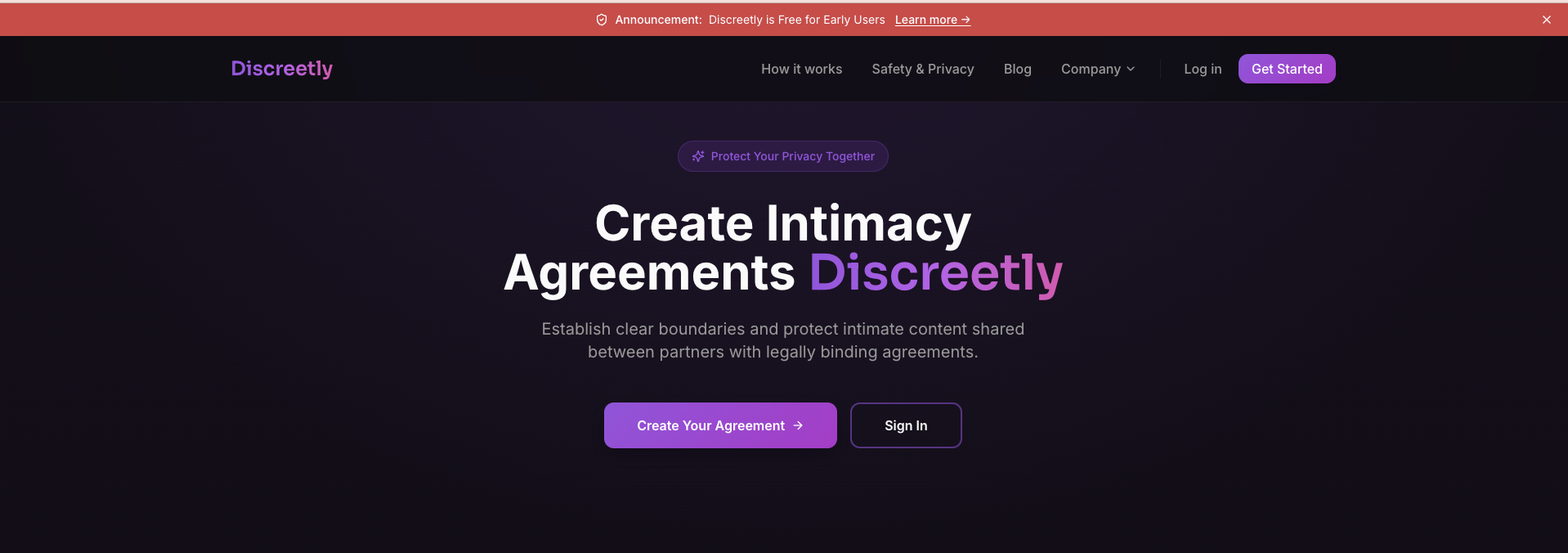
Words like "don't share this" carry zero legal weight. A signed NDA does. Under England and Wales contract law, a properly executed Non-Disclosure Agreement creates an enforceable confidentiality duty — and breaching it can lead to injunctions, damages and, where intimate images are involved, criminal prosecution under section 33 of the Criminal Justice and Courts Act 2015 and the Online Safety Act 2023.
Discreetly is built specifically for this.
Free for the basic agreement — create, send and sign at no cost.
Two-minute setup — name yourself, name your partner, send a secure signing link.
Partner doesn't need an account — they sign through a unique tokenised link.
Optional ID verification (an optional paid add-on) so the names on the contract are legally provable.
Tamper-proof PDF released only after both parties sign.
England and Wales jurisdiction, fixed legal template — no risky DIY clauses.
What an NDA Actually Protects You From
| Scenario | Without an NDA | With a Discreetly NDA |
|---|---|---|
| Partner reshares images after a breakup | You rely on criminal law alone — slow, traumatic, hard to prove intent | Civil breach of contract + criminal route. Faster injunctions. |
| Threat to share ("sextortion") | Hard to prove the original consent terms | Written, signed, time-stamped consent boundaries |
| Identity disputed ("that wasn't me") | He-said-she-said | Stripe ID-verified legal names on the document |
| Images appear on a porn site | Long takedown battle | Signed proof of confidentiality duty for hosts & courts |
Step 4 — Reduce What's in the Photo Itself
Crop your face out — or your tattoos, birthmarks and bedroom background.
Strip metadata — most messaging apps already do, but screenshots don't always.
Avoid mirrors and reflective surfaces that capture your phone, room or face.
Use disappearing-message mode on Signal or WhatsApp for an extra layer.
Never use cloud-synced screenshots — disable iCloud Photos for screenshots if you can.
Step 5 — Know Your UK Rights if Something Goes Wrong
If someone shares — or threatens to share — your intimate images without consent, you are the victim of a crime in England and Wales:
Section 33, Criminal Justice and Courts Act 2015 — "revenge porn" offence.
Online Safety Act 2023 — broadened offences to include threats and deepfakes, with no need to prove intent to cause distress.
Free, confidential support: Revenge Porn Helpline (UK) — 0345 6000 459.
In an emergency, dial 999. To report a crime, contact your local police or 101.
Bringing It All Together: The Safe Way to Send Nudes
Sending intimate images can be safe — but "safe" is a system, not a single action. Use a real E2EE app, only share with a trusted partner, verify identities if you've never met, and put a signed NDA in place before the first photo is sent. Discreetly handles the legal layer in minutes, for free, with optional government-ID verification when trust needs to be earned.